Analog speedometers are quick to read at a glance and mechanically simple, while digital speedometers are more precise and show more information like fuel, trip and clock. Digital meters are more sensitive to water, heat and voltage problems. Both types can be repaired by a meter specialist.
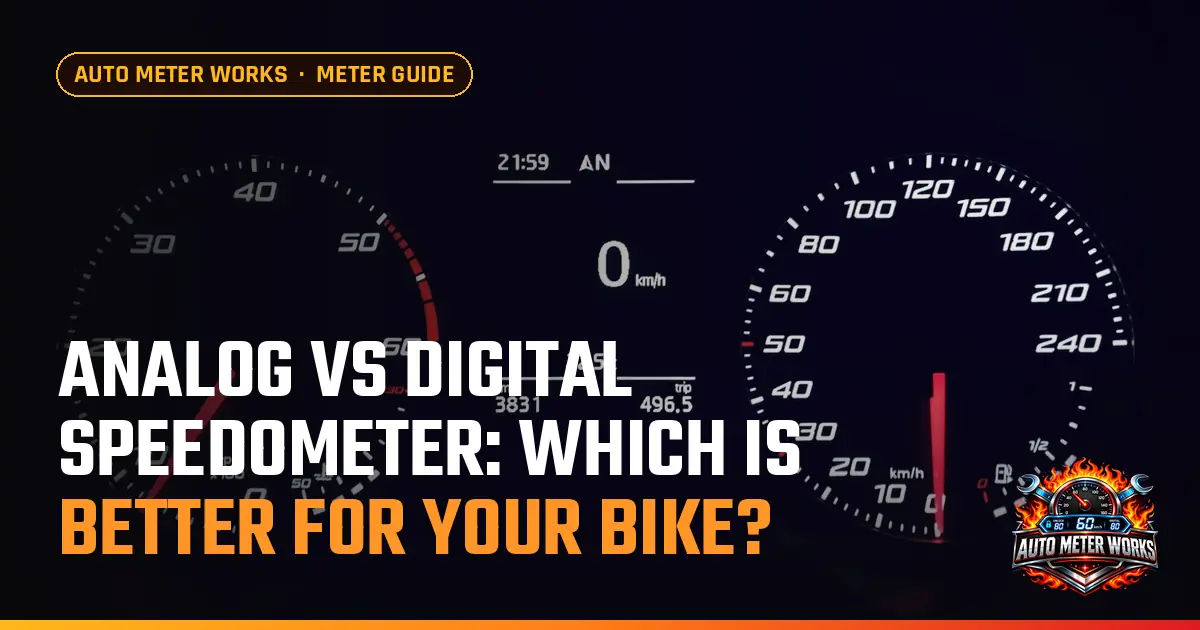
- Analog = quick glance reading, simple mechanics.
- Digital = more information and precise numbers.
- Changing type needs correct fitment and calibration.
- Keep a record of your old odometer reading.
Riders often ask us whether they should replace an old analog speedometer with a digital one, or go back to a classic needle after a digital meter fails. Both have advantages. Here is an honest comparison from a workshop that has repaired both kinds since 1986.
How each one works
An analog (manual) speedometer uses a needle. On older bikes the needle is moved by a spinning cable connected to the front wheel; on newer ones a small motor moves the needle based on an electronic signal.
A digital speedometer receives pulses from a speed sensor and shows the speed as numbers on an LCD or TFT screen, usually along with fuel, trip, clock, gear and service information.
Side-by-side comparison
- Reading at a glance: many riders find a needle quicker to read while riding; digital numbers are more precise.
- Information: digital meters show far more — trip meters, fuel bars, clock, gear position and alerts.
- Durability: cable-type analog meters are mechanically simple but the cable wears out. Digital meters have no cable but are more sensitive to water, heat and voltage problems.
- Repairs: analog faults are usually the cable, drive or needle mechanism. Digital faults are usually the display, backlight, sensor or circuit board — both are repairable by a specialist.
- Look: a classic needle suits retro bikes; a digital meter gives an older bike a modern look.
Things to check before you change your meter
- Fitment: the new meter must fit the handlebar or headlight mount and the wiring of your model.
- Signal type: a digital meter needs a sensor signal. If your bike has only a cable drive, a sensor has to be added.
- Calibration: the meter must be set for your tyre size, otherwise speed and distance readings will be wrong.
- Legal readings: the odometer should continue to reflect the vehicle's real use. Keep your old reading on record when changing a meter.
Not sure which suits your bike? Send us your bike model on WhatsApp and we will tell you what fits.
Buying a speedometer in Hyderabad
Besides repairs, Auto Meter Works keeps a wide range of speedometers — analog and digital — for two- and four-wheelers at our Ramkote shop. See the speedometers we sell, or if you would rather keep your original meter, our bike speedometer repair service can usually bring it back to working condition.
Frequently asked questions
Which is more reliable, analog or digital speedometer?
Both are reliable when fitted correctly. Analog meters wear mechanically; digital meters are more sensitive to water and voltage problems.
Can you convert an analog bike meter to digital?
Usually yes, with the right meter, a speed sensor and correct calibration. See our guide on fitting a digital speedometer to an older bike.
Speedometer and vehicle meter specialists in Ramkote, Hyderabad since 1986. We repair digital and manual meters for 2 & 4 wheelers and EV displays. About us · 78939 66701